

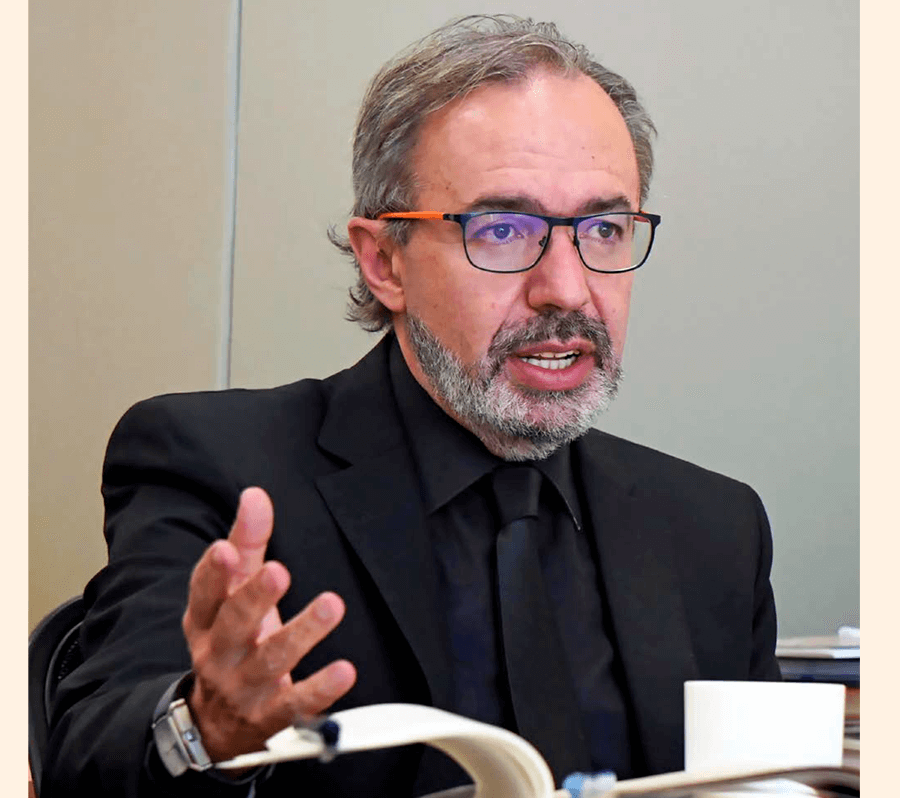
JORGE RICHTER: "By the end of the year, we will ALSO BE IMPORTING LPG"
In this crisis scenario, the vice-presidential candidate for MORENA proposed a technical audit to determine Bolivia’s actual gas reserves and called for a national agreement for lithium exploitation.
ISSUE 144 | 2025
Bolivia 2025 Presidential Forum: Energy, Economy, and the Future (*)
1What reforms do you propose for the hydrocarbons sector in light of the drop in gas production and exports?
Given the critical energy scenario with declining production and exports of natural gas and the likelihood that, by year-end, we will also be importing LPG and Jet Fuel we propose first conducting a technical audit to accurately determine real gas reserves. This is an essential foundation for planning production, domestic supply, and exports.

“In the case of YPFB, we propose converting it into an energy holding company, reducing the excessive functions of its headquarters and removing the burdensome state structure that currently limits its agility…”
Next, we propose three key reforms:
First, update the domestic gas price which has been frozen for two decades to send clear signals and attract investment.
Second, review the fiscal regime (IDH, royalties, and profit-sharing), which currently discourages investment in mature fields and makes us less competitive compared to other countries.
Third, allow private companies to market gas by modifying the legal framework that currently grants YPFB exclusive rights, thereby giving investors the guarantees they need to recover their investments and open new markets.
The objective is to rebuild trust, create an attractive environment for capital, and reverse the crisis in the hydrocarbons sector.
2What is your position on fuel subsidies and imports? Would you eliminate, reduce, or maintain the current model?
Eliminating or increasing the subsidy and raising gasoline or diesel prices alone is not enough, especially since Bolivia currently lacks dollars after losing its hydrocarbon revenues and cannot sustain imports amounting to roughly $3.3 billion a year. Therefore, we propose a gradual and structural solution: withdraw YPFB from the importation of expensive diesel and gasoline, while temporarily maintaining the state’s purchase of cheaper gasoline to avoid inflationary shocks. This would save foreign currency, relieve pressure on the exchange rate, ensure key external payments, and enable the creation of a stabilization fund to strengthen international reserves.
He was born in the city of Cochabamba. He studied at La Salle School in his hometown and then pursued Political Science at the Catholic University of Córdoba, Argentina. Later, he earned a master’s degree in Philosophy and Political Science at the Universidad Mayor de San Andrés in La Paz. To this day, he specializes in political and scenario analysis, the State, society, and socio-political processes. He was presidential spokesperson for President Luis Arce and is currently a vice-presidential candidate for the Movimiento de Renovación (MORENA).
In the short term, this would reduce fuel lines and send a macroeconomic responsibility signal to stabilize the country.
3What strategy do you propose to advance a real transition to renewable energies without compromising energy security, while coordinating efforts with the private sector and academia?
To foster a real transition to renewable energies without jeopardizing energy security, it is important to recognize that these sources are intermittent and will always need gas as backup, in addition to its key role in generating foreign income through exports. Therefore, we propose immediate action on three fronts: storage, transmission, and management of seasonal variations in renewables. Today, 70% of our electricity still depends on gas, although we have made progress in hydroelectricity (19%). However, beyond providing legal frameworks that offer investors certainty, it is essential to build these policies as State agreements, emerging from broad dialogue and consensus, to ensure sustainability in a country as diverse and politically and socially complex as Bolivia.
4What is your plan for exploiting lithium and other energy resources with added value, considering water access and management in the context of current geopolitical tensions?
Lithium and other strategic resources require a comprehensive approach due to their high complexity. Currently, agreements and contracts exist without a specific lithium law, revealing legal gaps. Moreover, there are conflicting positions among regional, union, civic, economic, and environmental actors especially in Potosí which hinders the development of a clear policy.
Thus, we propose that lithium exploitation and its value chain considering water management and geopolitical tensions not be based solely on isolated government decisions but rather emerge from a grand national agreement involving the central government, regions, businesses, social sectors, and the Legislative Assembly. Only through dialogue and consensus can a genuine national policy be designed to ensure national benefits, environmental sustainability, and social stability.
5How will you attract new Foreign Direct Investment (FDI) for energy exploration and technological renewal under a shared-risk model?
To attract FDI for energy exploration and technological renewal under a shared-risk model, it’s not enough to pass laws or promise legal security. It’s essential to guarantee political, social, and institutional stability making Bolivia a predictable and trustworthy country. This requires building broad agreements among regions, productive sectors, power groups, and the State recovering a culture of dialogue and collective policymaking. Only with solid institutions and social cohesion will investors trust that contracts are honored and commitments are kept.
Then, yes, it will be necessary to adjust the fiscal regime and reform the hydrocarbons law, possibly even with constitutional changes but everything must start from a grand national pact that provides certainty and positions Bolivia as a serious and competitive destination for foreign capital.
6What role do you assign to ENDE, YPFB, and other state-owned enterprises in the country’s new energy model?
YPFB, ENDE, and other state-owned enterprises like YLB are assigned a strategic role in the new energy model, based on two main pillars: First, providing legal protection to prevent them from becoming political spoils again ensuring technical management free from party interference; and Second, transforming them into competitive and sustainable companies through contracts with clear performance goals and sustainability criteria (social, financial, and operational).
Specifically, we propose converting YPFB into an energy holding company reducing excessive functions of its headquarters and freeing it from the state rigidity that currently limits its agility. In this way, YPFB, ENDE, and similar firms would cease to be bureaucratic structures and become efficient, results-oriented units key to driving the country's energy development.
7 What role should Bolivia play in the climate change agenda and international cooperation for sustainable development?
Bolivia, as a country vulnerable to climate change but rich in strategic resources like gas, lithium, and biodiversity, must assume an active role in the international climate agenda.
This involves:
• Defending climate justice under the principle of common but differentiated responsibilities from the Paris Agreement;
• Promoting debt-for-climate-action swaps by encouraging forest conservation and environmental protection projects;
• Accessing international financing such as green funds and programs from the IDB or CAF for renewable energy, resilient agriculture, and a just energy transition.
In addition, Bolivia must have a strong, non-ideological voice in international forums prioritizing national interest, regional integration, and sustainable development with climate justice.
“Access international financing such as green funds and IDB or CAF programs for renewable energy, resilient agriculture, and a just energy transition.”
(*) The Bolivia 2025 Presidential Forum: Energy, Economy, and the Future was organized by the National College of Economists of Bolivia (CNEB), the Private University of Santa Cruz de la Sierra (UPSA), and ENERGÍABolivia magazine, part of the CECAL S.R.L. Group. It took place on June 27, 2025.