

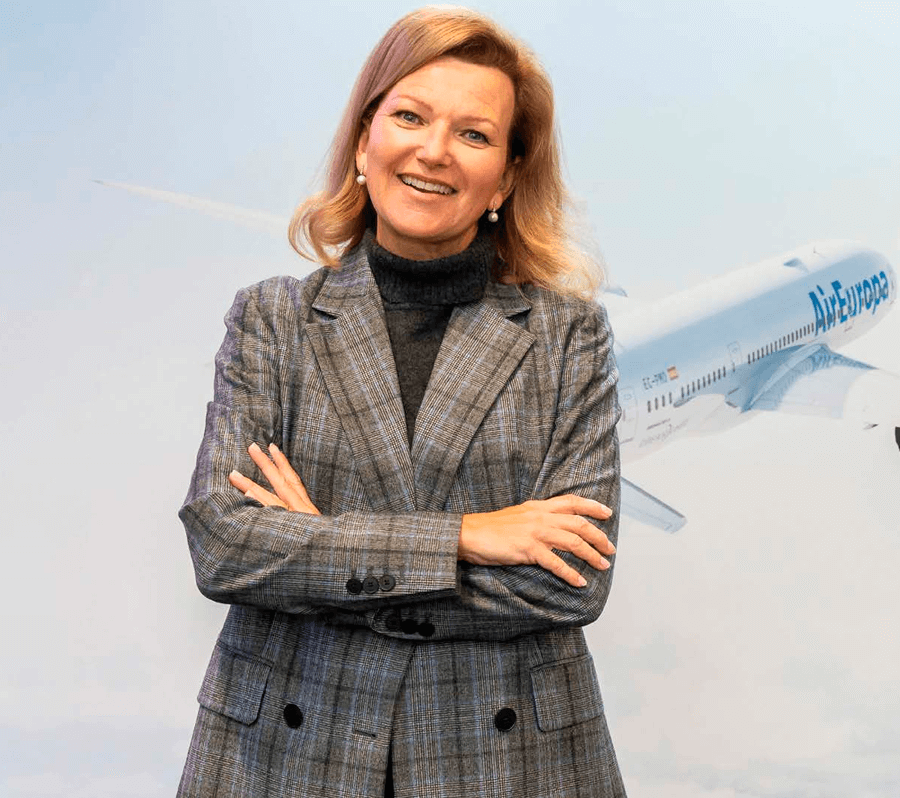
ROSA NORDFELDT RAMIS: “air europa is committed to a sustainable energy transition”
She believes that measures are essential to support the transition to more sustainable energy sources without penalizing a strategic market like commercial aviation.
ISSUE 144 | 2025
Vesna Marinkovic U.
1What is the scope of Air Europa’s sustainability policy?
Air Europa’s sustainability efforts are driven more by defined objectives than by budget estimates. Since 2015, Air Europa set a goal to reduce its emissions by 30% by 2030 a goal of which more than 21% has already been achieved. This success stems from a complete fleet renewal with more efficient aircraft, the use of SAF (Sustainable Aviation Fuel) since 2023, and the ongoing adoption of technologies that optimize operations and reduce fuel consumption. The airline emphasizes that this commitment is not reflected in an isolated budget, but rather permeates all its departments across the board.
2You mention the incorporation of SAF and more efficient aircraft. Could you detail how that process is developing and on which routes the use of sustainable fuel is currently prioritized?
As of this year, all airports classified as Union Airports must offer at least 2% SAF, which has allowed the airline to incorporate it regularly despite the limited production of this fuel. In fact, Air Europa began using SAF on select flights to Havana in 2023, and last year on the Madrid–Buenos Aires route.

“Digitalization has become essential to achieving our sustainability goals.”
3Is Air Europa promoting strategic alliances with SAF suppliers or research centers to accelerate this transition?
In recent years, we have signed agreements with Spain’s main SAF producers to secure early access to this fuel. This was essential, as both production and distribution are limited to the sector’s most prominent companies, which have the necessary resources to provide such services.
4What role do public policies and national or European incentives play in this path toward sustainability? Do you believe there is still a lack of regulatory support?
It is crucial to implement measures that do not penalize the sector but rather help it face the transition to more sustainable energy sources. Taxation should not be designed to punish such a strategic market as ours. We need actions that promote investment in energy efficiency measures.
We are aligned with the proposals from ALA (Airline Association) for a transition toward a more sustainable market, such as reforming the regulation of emissions trading rights and reviewing the kerosene tax. At a time when we are making significant investment efforts to meet decarbonization goals in a very short time while also trying to maintain accessibility to air transport for the entire population it does not seem reasonable that regulatory and fiscal measures could lead to increased costs, higher ticket prices, and consequently, a significant decrease in passenger numbers.
5From the passenger’s perspective, how are you communicating these sustainable actions? Have you noticed a shift in traveler awareness regarding the environmental impact of flying?
Customers are increasingly aware and demanding when it comes to sustainability, placing greater trust in airlines that take visible actions—such as using recyclable onboard materials, sourcing local products, or operating electric ground vehicles. Air Europa emphasizes the importance of communicating these advances to encourage the adoption of best practices. Its “Flight 2030” project already brings together more than 40 initiatives aimed at comprehensive sustainability. Additionally, the airline is part of SkyTeam’s “Aviation Challenge” to optimize flights and reduce environmental impact.
6What role does digitalization play in Air Europa’s operational sustainability efforts? Are you using artificial intelligence or big data to optimize routes, fuel consumption, or other processes?
Digitalization has become essential to achieving our sustainability goals. Some time ago, we implemented Electronic Flight Bag technology to eliminate paper use in pilot operations, and we use big data to calculate the most efficient routes. Last year, we integrated the OptiClimb application to provide crews with specific, tailored instructions for each flight on the optimal climb speed to minimize fuel consumption without compromising flight time. We estimate this will allow us to avoid emitting 10,100 tons of CO₂ this year.
We believe so strongly in data analysis and its potential at all levels that we’ve launched our +Air Data Academy an initiative to train 1,000 company professionals in data use to improve process efficiency. We are also using AI to optimize catering loading on flights.
7 Finally, if you had to define Air Europa’s sustainability commitment in one sentence, what would your key message be to our readers?
Air Europa is firmly convinced of the importance of progressing toward the decarbonization of the sector and especially of doing so in a way that keeps our operations, which are strategic for both national and international mobility, viable and profitable.
“We need to implement actions that drive investment in energy efficiency measures.”